

 Jeremy F. Plant and Jonathan W. Plant/photos by the authors
Growing up in a small town in upstate New York, the Northwest seemed as far away as you could get and stay in the Lower 48. That changed for Jonathan in 1975, after he married Elaine King, a native of Tacoma, Washington. The two relocated to Washington State, opening a new chapter in his rail photography career. It was enhanced further after he took a job as a publisher’s representative, visiting universities across the West, from Alaska to Texas.
I was just finishing my Ph.D. and working a 9-month job in academia, so it created a golden opportunity to visit my younger brother and combine a family visit with a chance to photograph rail lines in Washington and Oregon. In this article, we examine the smaller lines in the Northwest in the 1970s and 1980s that Jonathan and I explored at a time before many lines became victims of a changing economy and competition from trucks.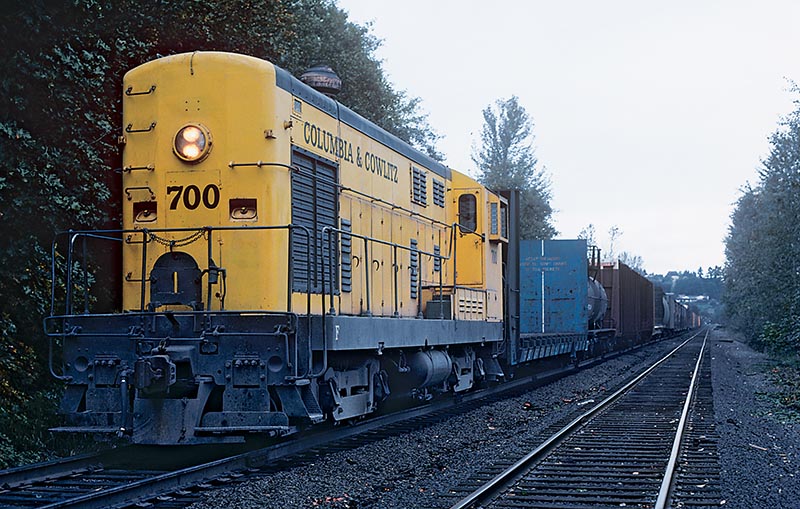
The Columbia & Cowlitz was a Weyerhaeuser-owned short line headquartered in Longview, Washington. It owned one Fairbanks-Morse switcher, H12-44 #700, seen leaving Longview with a good-sized train in October 1977. The 1200-horsepower diesel was built in May 1956 as their #D-2.
Many of these short lines were dependent on the forestry industry. The Northwest became a prime source of forest products in the early 20th century and railroads were needed to haul the timber out of the forests to the mills and to deliver finished products to market. Many of the forestry-related lines were owned by timber companies. Over time, the giants of the industry – Weyerhaeuser, Georgia Pacific and Rayonier, to name a few – grew to dominate and consolidate the rails in the forest.
While the forest industry was the key force in setting the short-line map of the Northwest, it was not the only factor leading to the creation of smaller railroads. Some, like the Yakima Valley in Washington and the Nez Perce in northwestern Idaho, served the local economy. Others worked the busy yards and ports of cities like Portland and Tacoma.
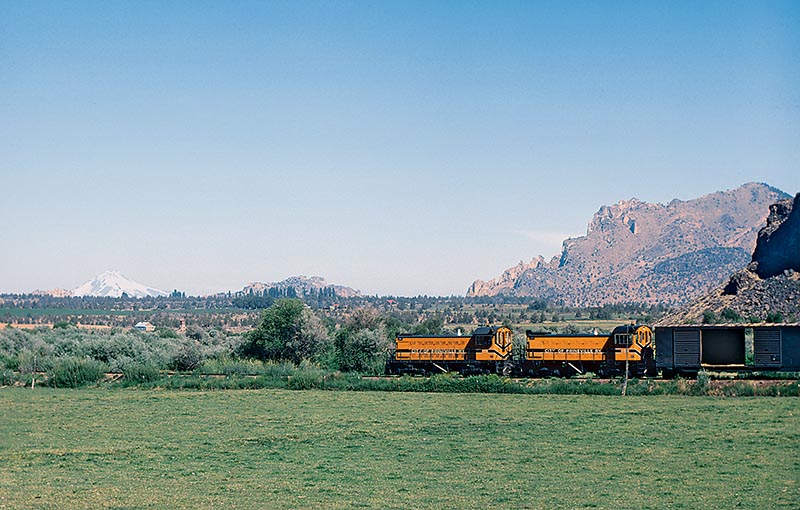
Snowy Mt. Jefferson, the second-highest mountain in Oregon, looms in the background as the westbound daily freight on the City of Prineville Railway passes irrigated farmland about halfway between Prineville and Prineville Junction. The COP is a lifeline for the businesses in the city after the Oregon Trunk Railway was built 19 miles to the west, leaving them stranded. The Oregon Trunk trackage here was owned by the Spokane, Portland & Seattle Railway (BN).
It was seldom smooth sailing for the region’s smaller roads. The forestry industry was quickly affected by the ups and downs of the economy, government regulations, and competition from Canada. The shifting ownership often disrupted rail operations. For railfans like us, it was a game of getting coverage of operations before it was too late. Photographing short lines in the region combined two main goals — showing the operations of the lines in their often-scenic settings and recording the locomotives used by the various roads. Fortunately, motive power was varied and colorful, ranging from six-axle Baldwins to C415’s and rebuilt U25B’s, with end-cab switchers from Fairbanks-Morse, ALCO, and EMD in service alongside GE 70-ton units and even electric motors on a former interurban line. We arrived just a few years too late for steam power, but for diesel enthusiasts, the region was a treasure-trove.
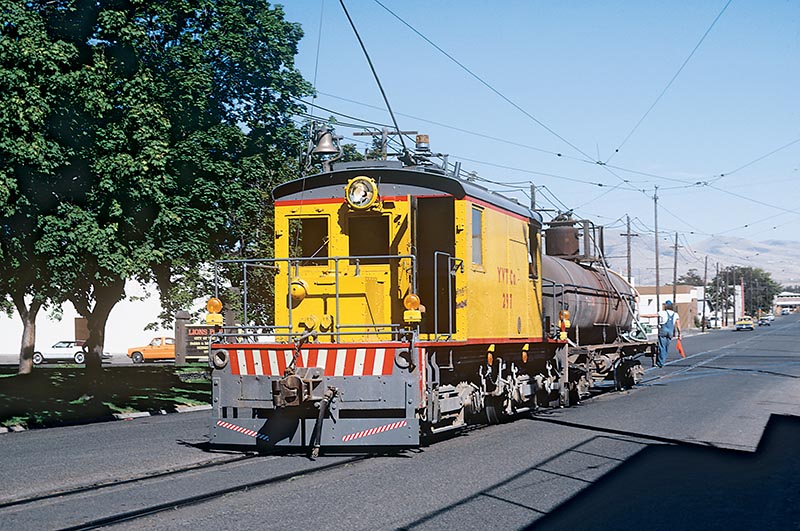
Jonathan was visiting friends in Yakima when he discovered Yakima Valley Transportation box cab electric #297 backing down West Pine Street in the city of Yakima with a tank car close to the Union Pacific interchange in May 1980. The venerable motor dated to 1923. After YVT freight operations ended in 1985, this unit was donated to the Orange Empire Railway Museum in Perris, California. A running theme in this article seems to be the surprising number of classic locomotives that thankfully have been preserved by railroad museums.
In this article, we will start near the center of Oregon and make a big loop that includes a quick trip into Idaho, back across Washington State to the shores of Puget Sound and down south through western Oregon to examine rail operations that include some of the last vestiges of timber and logging railroads in the broad region we call the Northwest. The time period is the mid-1970s to the early 1980s. The lines we visit include City of Prineville; Oregon & Northwestern; Union Railroad of Oregon; Nezperce; Yakima Valley Transportation Co.; Port Railroad of Tacoma and Tacoma Belt Railway; Simpson Lumber; Curtis, Milburn & Eastern; Columbus & Cowlitz; Portland Terminal; Longview, Portland & Northern; Weyerhaeuser rail operations around Springfield; Oregon, Pacific & Eastern; and Oregon, California & Eastern.
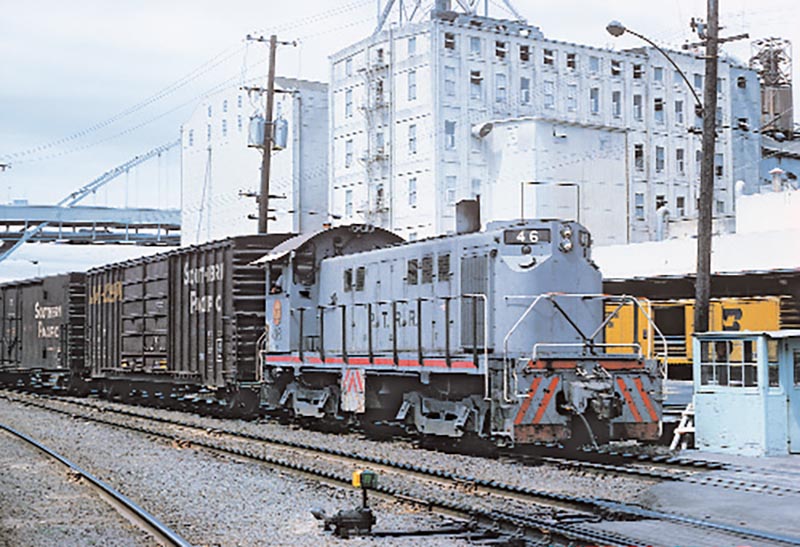
Portland Terminal’s T6 #46 is bringing a train of Southern Pacific boxcars south from Guilds Lake Yard near Portland Union Station in August 1976. The handsome ALCO was one of two on the PTRC; they were modern units acquired in 1968. The railroad was originally known as the Northern Pacific Terminal Company, but changed its name in 1965. It allowed equal access to owners Union Pacific and NP. That’s the beautiful double-decker Fremont Bridge gracefully crossing the Willamette River in the background. It was built in 1973 and carries traffic for both Interstate 405 and U.S. Route 30. I am standing close to the intersection of NW 13th Avenue and NW Savier Street.
Washington and Oregon Short Line Map
The map on page 25 is intended to give you a basic idea of where each of the short lines described in this article are located. Major rail-roads have been roughed in for perspective. You can readily find Oregon’s main lines, as there is only one east-west main in the state— the Union Pacific “Oregon Railway & Navigation Company” tracks following the south bank of the Columbia River at the very northern border, with the SP&S running parallel across the river in Washington. You can see the start of a second east-west main line that began to take shape at Ontario, Oregon. This is UP’s Burns Branch, which served as a lifeline for the Oregon & Northwestern timber railroad. Flooding of Malheur Lake resulted in the abandonment of both lines. North-south mains include: BN’s Oregon Trunk (ex-Great Northern south of Bend), meeting the SP Cascades Route (Natron Cutoff) from Eugene at Chemult, then going south to Klamath Falls; SP’s older Siskiyou Route from Portland heading south through Eugene and Medford; plus the Union Pacific’s Oregon Short Line that runs northwest from Ontario to Hinkle, where it turns west along the Columbia River.
Washington State has an abundance of east-west mains, including three Burlington Northern routes — Great Northern, Northern Pacific and the Spokane, Portland & Seattle, listed from north to south, with the Milwaukee Road electric line running right through the middle of the pack.
This map also gives a nice overview of the short line operators that handled lumber. Many of them were located relatively near the coast and served by SP’s Siskiyou Route.
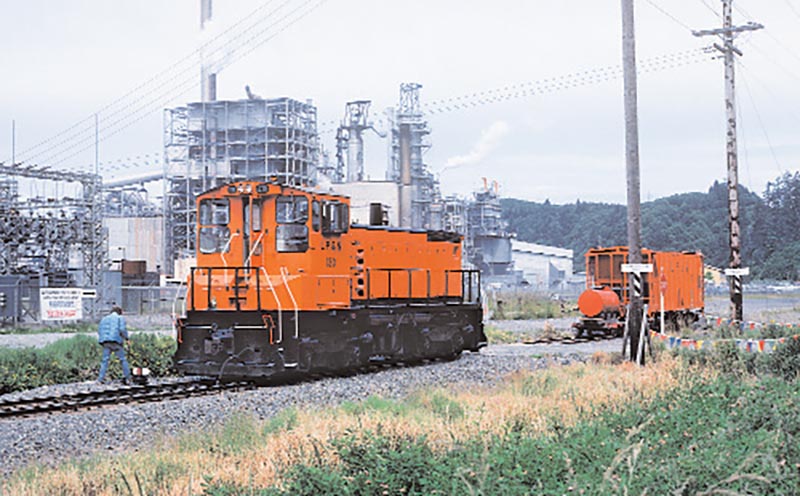
Longview, Portland and Northern SW1500 #130 switches the Gardiner Paper Mill at Gardiner, Oregon, in June 1980. The #130 was the only one of its type on this road, purchased new at the end of 1969. The railroad was unusual in having unconnected operations in both Oregon and Washington. The Long-Bell Lumber Company is responsible for building both the LP&N Railway and the paper mill seen here.
City of Prineville
Looking at the state map of Oregon suggested that a three-day trip from my family visit in Tacoma, Washington, in August 1976 would enable me to visit Portland and then head south and east to photograph two short lines I wanted to see: the City of Prineville and the Oregon & Northwestern, both of which operated in the vast inland part of Oregon east of the Cascades.
Recalling the first day, I remember leaving Portland early on a foggy morning. It was tough driving until I passed Mt. Hood and headed down into the beautiful country southeast of there. It was totally new country for me, and I was really excited to head into new territory, listening to the new album by Boz Skaggs and heading for Prineville. I heard the City of Prineville train left its namesake town for the BN connection in the morning. Sure enough, as soon as I took the turn to Prineville, I saw a headlight and two orange ALCO switchers approached with a decent-sized train. I chased it west and got a couple of shots, then set up at the junction and shot it coming in and switching the interchange. I was getting ready to head east to the O&NW at Burns when I saw the COP crew pointing to the BN. In the distance a headlight appeared a southbound ripped by with ALCO power – too good to pass up. I chased it the short distance to Bend, where it stopped. I had to decide what to do next, and it was tough to give up on the BN freight, but I wanted to get the Baldwins on the O&NW, so I ate a quick lunch and headed east across the high desert in my ridiculous rental car, a white AMC Pacer…