 Carl Graves/photos by the author
I don’t think we’re in Kansas anymore!
During my four decades of travels to watch trains and take railroad pictures, I grew to love many regions through which the trains ran. They include the Rocky Mountains, the Upper Mississippi, the Ouachita National Forest along the Oklahoma/Arkansas border, and the High Plains. As for the Northeast, I never really felt at home in this part of the country, even when I lived for three years in Massachusetts. In the 1970s, I took four brief trips (while on the move or doing research) to railfan areas new to me, including the West Virginia-Maryland border, Amtrak’s busy Northeast Corridor, and pockets of southeast Pennsylvania. In this article I will share with you some photos and memories of those visits. They opened up areas that were somewhat like the magical Land of Oz. Fortunately, during those brief excursions, I encountered no tornadoes, nor wicked witches, but like the dog Toto and her owner Dorothy, I decided to eventually return to Kansas, feeling there’s no place like home.
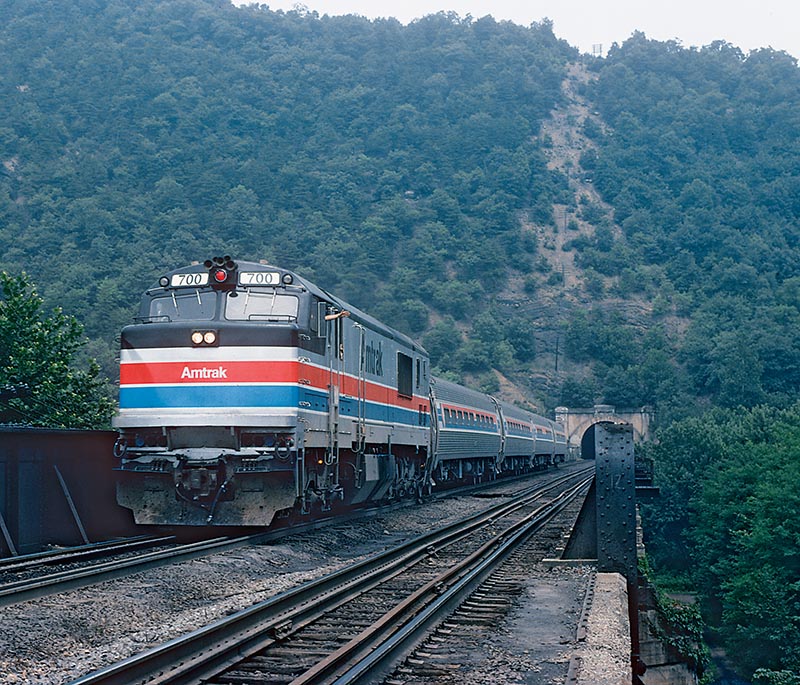
A short four-car Amtrak train, which I believe is the Blue Ridge, is led by the very clean P30CH class unit #700 in August 1976. I was pleased by the crewman’s friendly wave. This is the west portal of Graham Tunnel with the train on Kessler Bridge over the Potomac River, which separates Maryland and West Virginia in this area.
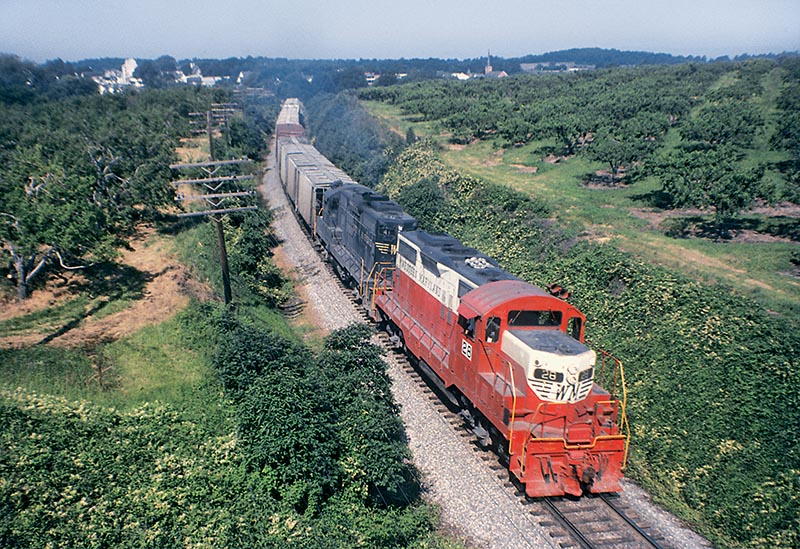
Until I was 22, I had lived nearly all my life in Oklahoma. I moved to Kansas in 1973 and have resided there for all but the years 1973-78, when I lived in Cambridge, Massachusetts, to do graduate history work. Long-time readers of TRP may recall that I wrote stories about my Bay State railfanning along the Boston & Maine and Penn Central/Conrail (TRP 2011 Issue #91 and TRP 3Q 2019). The first brief Northeast railfan experience occurred when my wife and I were moving from Kansas to Cambridge in June 1975. On the second day of our journey, we arrived at Greenbelt, Maryland, which was home of my train-watching friend Dale Jacobson and his wife. The next morning, while our car and the U-Haul truck sat in the street and my wife and his wife spent time together, Dale and I took off north and west in his car. We photographed colorful red-and-white Western Maryland Railway diesel locomotives on trains in or near Hagerstown, Reid, and North Branch, Maryland. We also encountered a Reading Company ALCO C424 leading a WM run-through train somewhere between New Franklin and Chambersburg, Pennsylvania. At the Western Maryland roundhouse in Hagerstown, we even found a very rare BL2 yard engine with a slug. Before we headed back to Greenbelt, we also managed to snare shots of Norfolk & Western trains at or near Hagerstown’s Vardo Yard, which was also known as Shomo Yard by Penn Central personnel. Black-and-white N&W power was no thrill, but the Western Maryland and Reading diesels were exciting to me. The rural countryside through which they traveled was also pleasant to look at, though not spectacular.
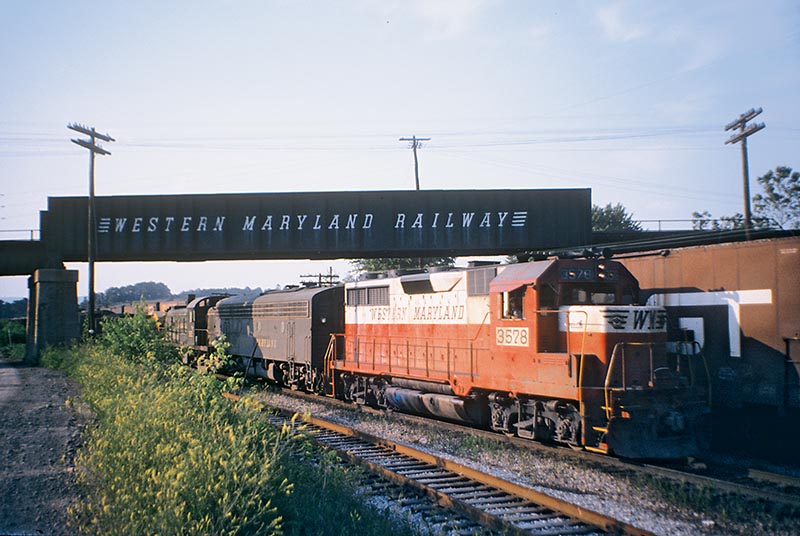
An eastbound freight powered by the very unusual combination of Western Maryland GP35 #3578, an F7A and an ALCO RS3 is traveling down the Baltimore & Ohio main line at North Branch, Maryland, a few miles east of Cumberland, in June 1975. The train is ducking under the former Western Maryland main line, which was now largely quiet; most freight trains recently started utilizing the parallel B&O route as WM operations were folded into Chessie System.
The next morning, my wife Cheri and I were back out the highway, driving our car and the truck to Cambridge, where we had leased an apartment. Trip two occurred a year later. With Cheri, I drove our ‘69 AMC Javelin from Cambridge to Greenbelt in August 1976 on our way back to Oklahoma to visit our parents. In Greenbelt, we also met up with my long-time Oklahoma railfan friend Paul Walters. The three of us took off in Dale’s VW Bug, leaving Cheri with Dale’s wife to explore local sites. Dale told Paul and me that among other places, we would visit the Magnolia Cutoff, a series of bridges and four tunnels constructed to eliminate miles of B&O tracks that wound around the Potomac River bank. I learned later that only part of the time were we on the Cutoff. We spent time north of the river along the roughly parallel Western Maryland route (for that trackage, see the article written by Alex Mayes, “CSX’s Spectacular Magnolia Cutoff,” in TRP July/Aug/Sept 2007). This Appalachian-style scenery was exotic and invigorating. I envisioned Dorothy saying to me, “Something tells me we’re not in Kansas anymore.” Years later, Paul wrote about the trip in his Waltersrail blog. He does not mention that I was with him on that day! Such is the lot of old folks like us, who sometimes struggle to recall certain details from the past.
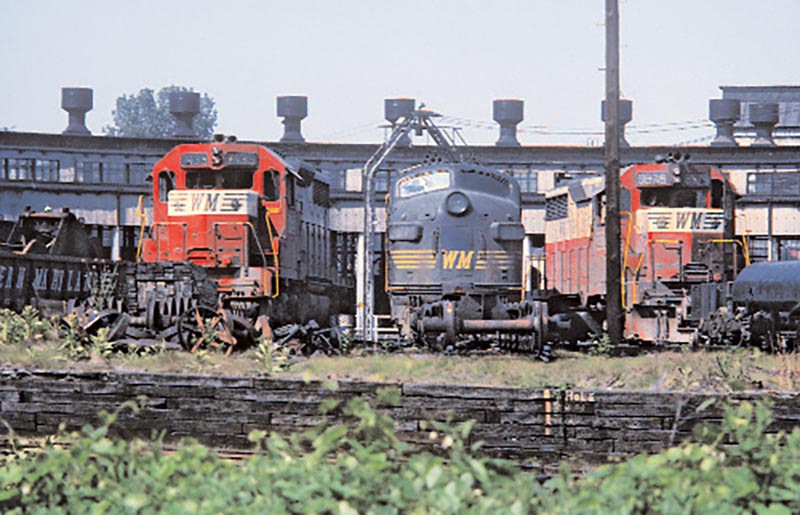
A Western Maryland SD35, an F7A and a GP35 are resting at WM’s roundhouse in Hagerstown, Maryland, in June 1975. Reading power could often be found here, too, due to their robust run-through operation.
Among the surviving photos in my slide box from that day was an elevated image of an eastbound Chessie System loaded coal train in West Virginia just west of Great Cacapon between Hancock, Maryland, and Orleans Crossroads. The three of us took some photos from a Great Cacapon-area railroad signal bridge, a practice that seemed much safer and accepted here than in the Kansas City metro area where Paul and I had once generated the ire of a Santa Fe Railway policeman for our gymnastics. I found a coal train led by a Baltimore & Ohio GP35 exiting the west portal of Randolph Tunnel on the Magnolia Cutoff and a loaded coal train with a bright yellow bay window caboose entering the tunnel to be especially interesting. That day we also photographed a short Amtrak train exiting Graham Tunnel. I had not seen railroad tunnels in Kansas. We then captured a coal load going through Little Orleans, West Virginia. Also intriguing was a B&O unit running long-hood forward and leading a manifest through the hilly, wooded country. We followed the line along a railroad gravel road that many locals also used. I also shot a manifest crawling by the site of a derailment at a location one railroad worker said was Turkey Run. (We didn’t see any domesticated or wild turkeys running or walking at the spot.)
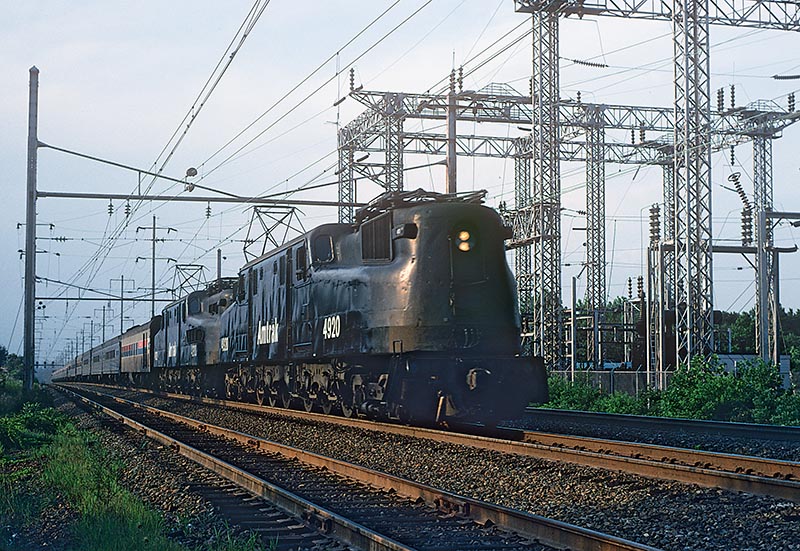
A long southbound Amtrak passenger train led by a pair of matching Amtrak GG-1’s still wearing Penn Central basic black is rolling through Severn, Maryland, on the busy Northeast Corridor in June 1979. Kansas has no such locomotives nor overhead electric wires. The electrical complex on the right is Substation #22 that was built in 1935 as part of the Pennsylvania Railroad’s original electrification program for the Northeast Corridor. This substation converts 138,000 volts to a usable 12,000 volts to energize the catenary properly, allowing the 4920 and 4930 to keep moving with near-constant voltage.
Finally, there was our general store stop in Paw Paw, West Virginia, population 706. The three of us burst into the place, excited about what we had photographed so far, and were eager to grab some snacks before returning trackside. I still recall the icy stares from the local proprietor and several customers, who probably viewed us as crazed Yankee outsiders. We lowered our voices, purchased some items, and left quietly. At day’s end, Dale’s little VW bug transported us back to Greenbelt. The next morning, Cheri and I left to drive back to Oklahoma to visit our parents’ homes in Edmond before returning to Cambridge. Paul later wrote that this day-long excursion began with fog and low clouds, which fortunately lifted enough to get photos. Paul also recalled that at Orleans Crossroad, he accidentally broke his glasses. Since his vision was horrible to begin with, he just aimed his camera in the general direction of an approaching train and pressed the shutter, sometimes with hilarious results…