

 David Baer/photos by the author except where noted
The engineer has his work cut out for him… start a 6,000-ton train up a slight grade over a road crossing with three four-axle units totaling 5200 horsepower. The engineer releases the train brakes and slowly begins to notch out the units, with two U18B’s bracketing a GP16. The sound is incredible, as the unique sound of GE’s U18B’s mixes with the EMD GP16. Ever so slowly, the train begins to move. It takes the engineer about ten minutes to get the train over the road crossing as he heads into the setting sun. You’ve just witnessed an amazing show that will soon disappear, as new power is arriving to replace the worn-out power that has been in use in this demanding service for the last 15 years. Welcome to another day in CSX’s “Bone Valley” in Florida during the winter of 1990.
Bone Valley
Bone Valley, an expansive region located in west central Florida, is the largest source of phosphate in the United States. It’s used in the production of agricultural fertilizer. The term “Bone Valley” originated when fossils were discovered in the area containing the phosphate deposits. Phosphate was first discovered along the Peace River near Arcadia in the 1880’s and the first railcars of that mineral were loaded by 1889. They were hauled on the narrow-gauge Florida Southern Railway, which had built through Arcadia in 1886. Soon, a web of lines served many new mines constructed after the turn of the century. As the technology developed, phosphate was dug out of the ground by large cranes, processed into “wet rock,” loaded into railcars and shipped to another plant where it was further processed into “dry rock,” or fertilizer. After it was refined, the dry rock was shipped via rail to ports located south of Tampa, along the Gulf Coast, where it was loaded onto ships. Processed phosphate and fertilizer was also shipped across the U.S. on land. Both Atlantic Coast Line (ACL) and Seaboard Air Line (SAL) built into Bone Valley to serve the different mines and processing plants. In addition, both roads served different ports along the Gulf Coast. In 1967, the ACL and SAL merged to form the Seaboard Coast Line (SCL), which continued to invest money in Bone Valley, as tonnage continued to increase. In the late 1970’s, SCL became part of Family Lines and then Seaboard System, before merging with the Chessie System to become CSX.
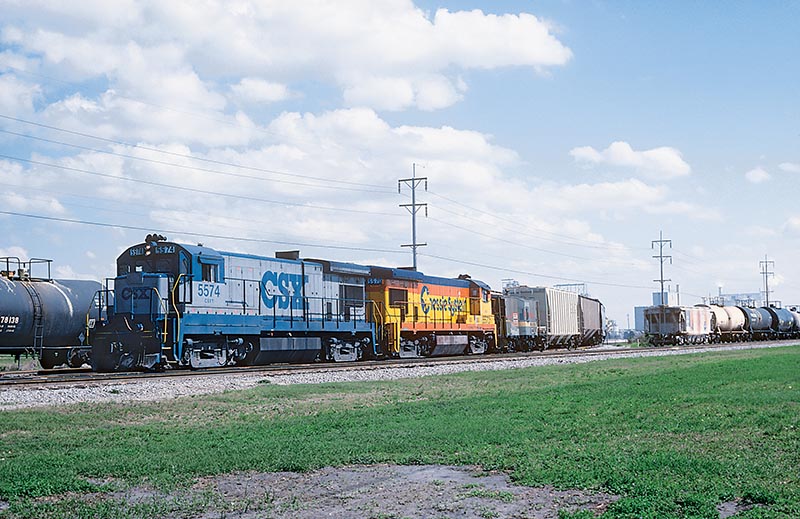
The variety of four-axle power operating on CSX in the Bone Valley area in early 1990 was amazing. After dropping off my parents at the hotel in Orlando, I headed southwest into the valley. The first CSX train I found was at the large Farmland Industries plant in Green Bay (Florida, not Wisconsin) along Route 640 east of Achan Junction on February 26, 1990. Green Bay is located on CSX’s Bone Valley Subdivision southeast of Mulberry Yard, the main CSX yard in the valley. From the shoulder of Route 640, the CSX local is seen working the west end of the plant powered by a pair of former C&O B30-7’s, with CSX blue and gray #5574 and sister #5570 still wearing Chessie System paint. Due to the need to shove their train onto various spurs and industries, this local has a Family Lines caboose coupled to the power. CSX operated a large fleet of General Electric B30-7’s assigned CSX 5517–5580 purchased in five separate orders by C&O. These two units were from the last C&O order of B30-7’s that were built in 1981 and numbered 8279–8298.
During the early diesel years, both SAL and ACL leaned heavily on their fleets of EMD GP7’s and GP9’s, along with ALCO RS3’s, to move the heavy tonnage out of Bone Valley. After the SCL merger, needing to replace the tired ALCO’s and early EMD’s in Bone Valley service, SCL turned to General Electric. In the 1970’s, SCL began purchasing GE’s new U36B, ultimately acquiring a fleet of 108 units. The only other U36B’s built by GE were 13 purchased by Auto Train and four by Conrail. SCL also acquired 25 “MATE’s” from GE in 1971. GE called these units “Motors to Assist Tractive Effort,” or MATE, for short. These were road slugs that relied on an engine equipped with slug connections or a “mother” unit, which happened to be 25 U36B’s that were also purchased in 1971. There were ten “single ended MATE’s,” which only received power from one mother unit and 15 “double ended MATE’s,” which could receive power from two “mothers.” In addition, the MATE’s were equipped with fuel tanks and could transfer fuel to its mother unit. SCL went to the other end of the horsepower spectrum and purchased 105 U18B’s from GE beginning in 1973. Several of these units were “light weight” diesels to be used on branches with light rail. The rest of them were scattered and used across the SCL system, with many of the units used in Bone Valley service. Photo research suggested the SCL U36B mother units and the MATE’s received a class overhaul in the early 1980’s after a decade of hard service in Bone Valley, with the units receiving gray Seaboard System paint.
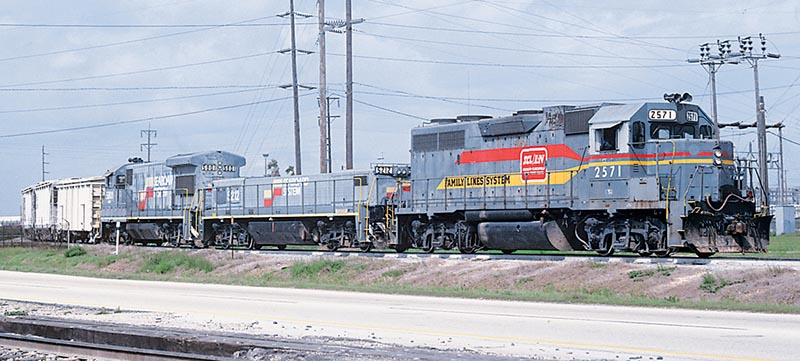
The afternoon of Tuesday, February 27, 1990, was spent exploring Bone Valley. Heading toward the Bone Valley Subdivision south of Mulberry, the first catch of the day was a phosphate train shoving into the Armour plant at Ridgewood, off the Valrico Sub, just west of Bartow. The train had just crossed Route 60, seen in the foreground, and is shoving into the plant with an interesting consist — Family Lines GP38-2 #2571 working with a Seaboard System slug set consisting of U36B #5801 working with MATE #5212. In the summer of 1971, General Electric built 25 single- and double-ended road slugs for Seaboard Coast Line called MATE’s, short for “Motors for Added Tractive Effort.” Built as SCL #3200–3224, these units became CSX #5200–5224. Each MATE was controlled by a U36B and sent to Florida to be used in phosphate service, where they were successful. Many of these sets were rebuilt and repainted into Seaboard System colors during the mid-1980s.
The Great CSX Melting Pot
CSX Corporation was formed in 1980 when Chessie System merged with Seaboard Coast Line Industries, two holding companies. They remained holding companies until 1986, with the merger finally completed in 1987. They began blending the motive power of both companies in 1985, creating the great “CSX Melting Pot.” Both the Chessie System and Seaboard System had large complex rosters with units from many predecessors remaining in older paint schemes. In addition, CSX created their first paint scheme, blue and gray, in 1985 and began repainting units. They started making modifications and went through a couple different paint schemes before settling on the “Bright Future” paint scheme in 1990. The late ‘80s were colorful years to spend time on CSX…