

 Gale E. Treiber/photos by the author
In 1770, Monterey became the first Spanish settlement in Northern California. In that year, Father Junipero Serra arrived by sea to build one of California’s Missions, and Captain Gaspar de Portola arrived by land with a small party to build a fort, a customs house and other government buildings. Monterey then became the capital of the northern portion of Spanish Alta California. After the War of Mexican Independence, it became the capital of Mexican California, and then after the Mexican-American War of 1841, Monterey became the capital of the U.S. Territory of California until 1849, when California’s capital was moved north to San Jose.
Sitting on the south shore of deep-water Monterey Bay, the town of Monterey might have become a major deep-water seaport –except, as its inhabitants soon learned, the bay was too open, making the town and its waterfront vulnerable to severe damage by major storms from the northwest. Almost due east of Monterey, but separated by a coastal mountain range, was the town of Salinas in the very fertile Salinas Valley. At this time, wheat was the valley’s major crop, but getting it out of the valley to market was quite difficult. Their situation somewhat improved in 1872 when the Southern Pacific Railroad reached Salinas on what would eventually become their “Coast Line” to Los Angeles. However, Southern Pacific was a monopoly, and it set their price for shipping wheat so high that the farmers could barely make a profit. Their solution was to build their own railroad from Salinas to Monterey. After several attempts they completed their 18-mile, three-foot gauge Monterey and Salinas Valley Railroad between the two towns, built warehouses in both towns and made improvements to Monterey’s waterfront. The little line struggled along for several years, fighting winter storms, bridge washouts and drought. With little steady revenue other than from passenger traffic, the railroad floundered and was taken over by SP in 1879. The part of the line from Salinas to the Monterey Bay coast was abandoned, while the remainder, from the Salinas River to the town of Monterey, was quickly converted from narrow to standard gauge and connected SP’s Coast Line at Castroville, thus creating SP’s Monterey Branch. An extension soon took the branch another 4.3 miles from Monterey through Pacific Grove to Lake Majella, and the SP then moved its locomotive servicing facility from Monterey to Pacific Grove.
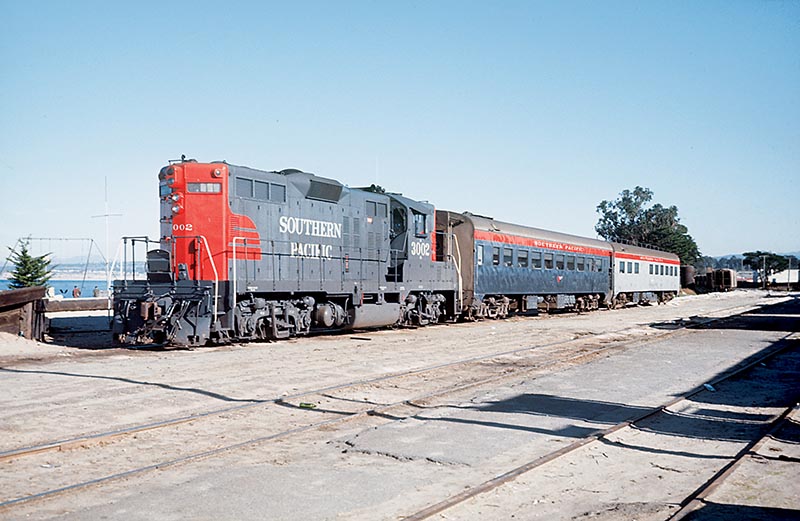
Now that we have seen the freight-only portion of the line, here is the Del Monte, the Monterey Branch’s daily passenger train. This view shows it in the evening, parked for the night after its 115-mile, three hour and ten-minute run from San Francisco to Monterey. It arrived as train number 126, and will leave in the morning as train number 141. This is its typical consist — a passenger GP9 with dual controls for the engineer, a reclining chair coach and a “Parlor Snack Lounge Car with Reserved Seats.” This day’s locomotive, #3002, brought the Del Monte from San Jose to Monterey running long hood forward.
Monterey remained somewhat of a sleepy town and did not grow until later in the Nineteenth Century when Charles Crocker, one of the “Big Four” sponsors of the Central Pacific portion of our nation’s first transcontinental railroad, visited Monterey and saw its beauty and realized its potential for becoming a major tourist destination. Through an SP-controlled subsidiary, a large tract of land was purchased that reached from Monterey southward to present day Pebble Beach and Carmel. A grand resort hotel, the Del Monte, was built and the Southern Pacific advertised the complex — with its golf, swimming, fishing, hunting, horse racing, or just relaxing and enjoying the Monterey Peninsula’s scenery and mild summer and winter climate — as the finest luxury hotel in America. The Hotel Del Monte soon became the equivalent of Newport, Rhode Island, for the West Coast’s rich and famous, and by the end of the Nineteenth Century, Monterey was served by five SP passenger trains per day. to Railroad patronage dropped off as new roads were built to Monterey and the Great Depression, and then World War II, reduced the desire and availability for luxury travel, so much so that the U.S. Navy was able to lease the main hotel building during the War to be used as a pilots’ ground school. And then, after the end of the War, the Navy purchased the hotel and its immediate grounds in 1949, and in 1951 moved its Naval Post Graduate School from Annapolis to Monterey.
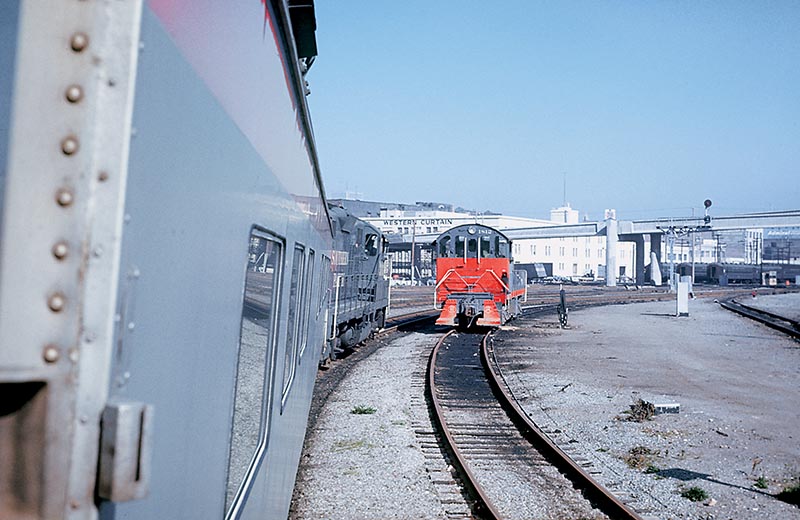
This wide, sweeping five-track curve was located just south of San Francisco’s Coach Yard. The crew of ALCO S4 switcher #1812 probably was having a much more leisurely time this Saturday than would be experienced when clearing the inbound platform tracks during a weekday’s morning rush hour.
And this is where I enter this story… after several assignments in my early naval career, I received orders to the Naval Post Graduate School and arrived in Monterey in the summer of 1970. At that time, Southern Pacific’s Monterey Branch was still reasonably active, with their one passenger train, the Del Monte, running to San Francisco and back seven days per week, and a local freight train serving peninsula customers running weekdays only. Unfortunately, with a full workload at school and two very young children, I did not have much time for photographing trains. I did have a few days off between semesters and an occasional day on a weekend. The best of my color slides that were taken then are presented in this article.
By the early 1970s, much of the Monterey Branch freight traffic had vanished; first, when the sardines disappeared from Monterey Bay just after WWII, and then when general freight was lost to trucks in the following years. Most of what remained was sand transported from the two sand processing plants at the very end of the branch at what was called Lake Majella. Trains with a dozen or more loaded covered hoppers or boxcars carried bulk or bagged sand from that area every weekday. The sand was quite fine, and rumor among the railfan community was that the bulk sand was being shipped to Hawaii for the replenishment of sand at Waikiki Beach. (Well, maybe. I’m not sure I ever really believed that)…