

 by Staff/photos as noted
Fifty years since the birth of Conrail? A reasonable question would be, “Why there was a need for Conrail in the first place?” Likely the best answer you could find would be in the United States Railway Administration’s Preliminary System Plan that specu-lates as to why the railroads were in the condition they were in and what they were going to do to mend that. It’s hard to find consensus about anything, but I think we can all agree that it was set in motion by the 1968 merger between the Pennsylvania Railroad and the New York Central (and hey, lets throw a railroad with a mega-sized commuter operation, the New Haven, in with it, too, on the last day of the year, while we’re at it) into Penn Central on February 1, 1968, and its quickly ensuing Section 77 bankruptcy filed on June 21, 1970.
For a government publication, the System Plan is thoroughly entertaining. You only have to go to page 7 to find this gem: “The legacy of railroading in the Northeast would lead many to believe correctly that successful management of the merged railroads would be a miraculous and almost unattainable goal. One study refers to the Penn Central merger as a birth of a grotesque set of Siamese twins.”
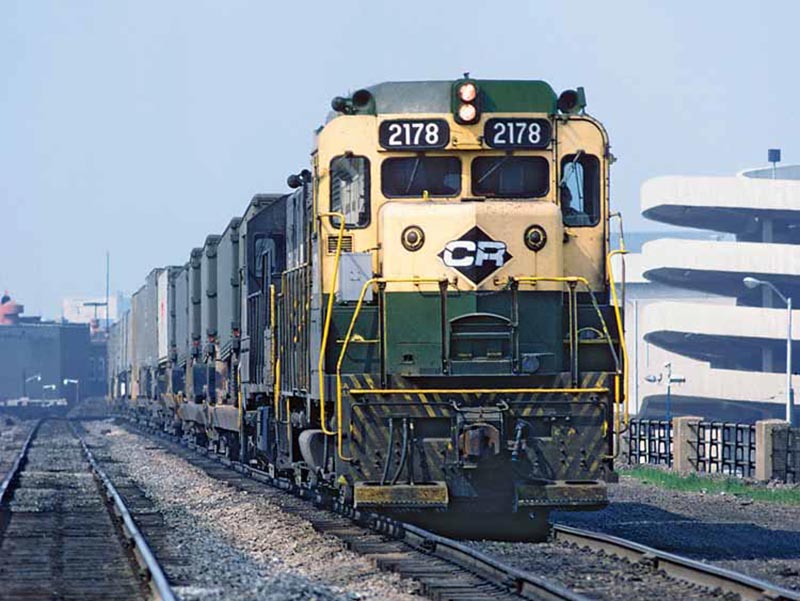
ABOVE: Former Reading GP30 3610, now wearing Conrail 2178, is on the point of train TV-4 sitting impatiently at Pine Street interlocking on the Dayton Union Railway on the morning of May 25, 1977. The crew has already been passed by a Baltimore & Ohio mixed freight and is waiting for Amtrak Train 31, the westbound National Limited to pass before proceeding east. Train TV-4 is a red-hot piggyback train running from East St. Louis to Meadows Yard in Kearny, N.J., so it’s interesting to see it powered by a GP30 and an elderly U-boat! It really is quite a shock to those of us who photographed this train toward the end of Conrail’s independent years when it carried UPS trailers from Indianapolis to Kearny. GP30… sure! —Kodachrome by David P. Oroszi
They even recommend that Amtrak should study implementing “Auto-Ferry” service, similar to Auto-Train, on two Conrail main lines and each would serve the Chicago market. One would be based out of Albany, New York, using the ex-NYC Water Level Route and the other with a terminal in Harrisburg, Pa., so they could clog up the Middle Division and its climb to Gallitzin with a long and heavy passenger train.
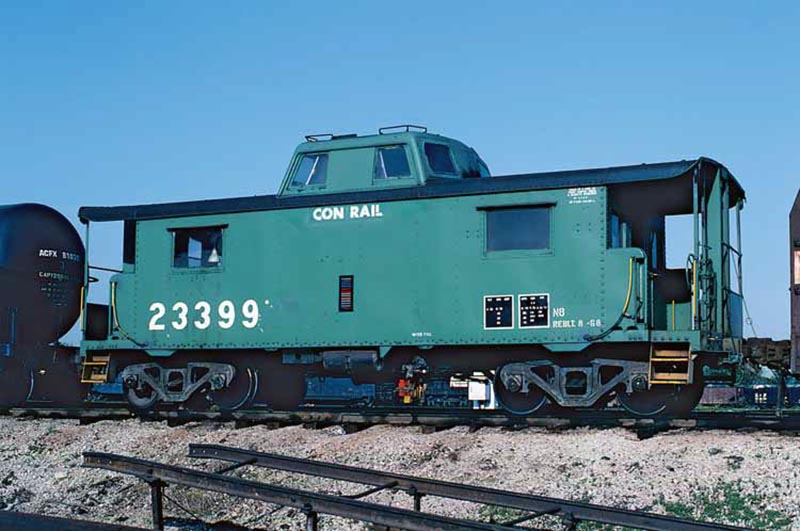
ABOVE: Conrail N8-class caboose 23399 was built by Pennsylvania Railroad in April 1951. It was one of 200 N8 cabins built by the Pennsy and was overhauled by Penn Central in August 1968. Notice that it actually was relettered for Conrail, as many quick repaints merely received “CR” stencils to update the reporting marks. This is a really early effort, seen at Sharonville, Ohio, on May 4, 1976. The 23399 kept its number and eventually wore a full coat of Conrail blue with standard lettering. —Dan Dover Collection, courtesy of David P. Oroszi.
It wasn’t just the PC bankruptcy. Each of the other five railroads lost revenue to all-Penn Central routing of traffic that once was hand-ed off to them by PRR or NYC. Railroads were already suffering from the development of the Interstate Highway system and jet trav-el. Penn Central just fanned the flames of the financial fire that had been smoldering for decades. In 1972, Hurricane Agnes dropped 18 inches of rain on… Florida? No. Louisiana? No. South Carolina? No. Schuylkill County, Pennsylvania, and the surrounding region got their share, as well. The Erie Lackawanna and Penn Central took the worst of it and EL declared Section 77 bankruptcy in Cleveland courts immediately after the storm hit.
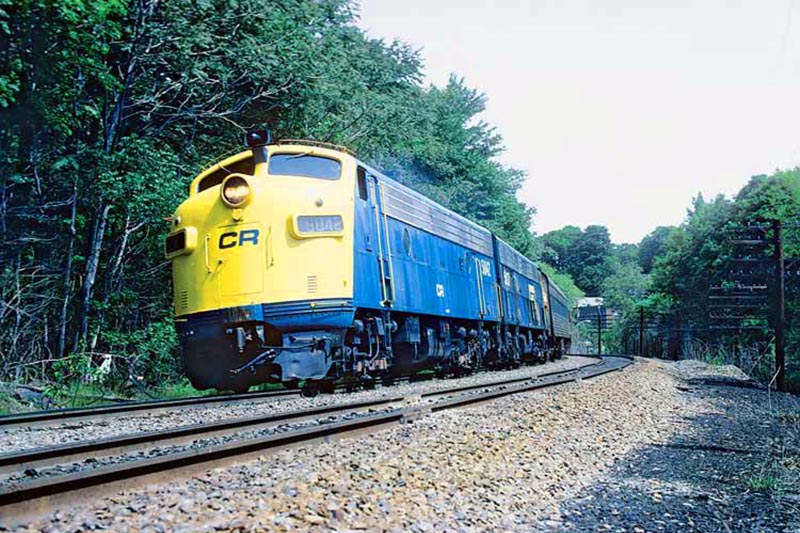
ABOVE: One of Penn Central’s brightest locomotives is on the point of a commuter train at Brewster, N.Y., on May 27, 1977. Now wearing a Conrail stencil on the nose, FL9 5042 represents the commuter-era, which mercifully ended on December 31, 1982, much to the delight of Conrail management. Some of the passenger trains that they had been forced to operate included Erie Lackawanna’s Cleveland-Youngstown trains, the Valparaiso “Dummy” (nickname going way back to early Pennsylvania Railroad days, which I believe derived from being “all-stops local” train as opposed to an express) from Chicago and various commuter operations serving major cities in the Northeast. —Kevin EuDaly Collection.
If it weren’t for that storm and if Erie Lackawanna could have remained independent, they could have become one of the financially strongest railroads in the Northeast, for just 12 years after Agnes, the first double stack train crossed Starrucca Viaduct on Conrail’s former Erie main line. The EL was perfectly positioned due to the fact that predecessor Erie was built as a broad gauge with generous clearances. It took years for other routes to be modified to accept these lucrative trains and EL would have had nearly 100% of the New York, New Jersey, and New England market share for years…