

 by Gordon Lloyd, Jr./photos from the Lloyd Transportation Library
The 1968 Warner Brothers movie Bullitt, starring Steve McQueen as San Francisco Police Lieutenant Frank Bullitt, ranks high in my personal “memories” while growing up in San Francisco Bay Area. The scenes that were depicted in the classic San Francisco-oriented film were easy to identify, having passed them many times during multiple excursions through the city seeking railroad, streetcar, cable car and trolley-bus photographs. The hilly street vistas still evoke memories of driving on that same pavement, though my vehicles were hardly as memorable as the Highland Green 1968 Ford Mustang GT fastback. I have to admit that, on occasion, as my camera was pointed at deserving subjects, the adrenaline may have been as high as during those Bullitt chase scenes! Other movies, TV shows and music punctuate those reminiscences. The “Dirty Harry” movie series, films about Alcatraz, such as The Birdman of Alcatraz and The Rock and classics such as Alfred Hitchcock’s Vertigo spring to mind. Though I’m not really a TV person, shows with a San Francisco venue included Ironside, The Streets of San Francisco, McMillan & Wife, and Tony Shalhoub’s quirky character in Monk. Music from San Francisco always seemed to be on the cutting edge — jazz in the 1950s and rock in the 1960s personified by The Jefferson Airplane, Grateful Dead and Jimi Hendrix.
For millions of travelers, San Francisco became one of those must-see destinations. People from around the world wanted to ride the little cable cars that climbed halfway to the stars, drive on winding Lombard Street, cross the Golden Gate Bridge and eat seafood and sourdough bread at Fisherman’s Wharf. It was hard to beat. For the readers of this magazine, many of the above interests might be held in common with the masses who have visited San Francisco in the post-World War II era. But our fascinations would be broadened with the desire to see and photograph the wide array of transportation subjects to be found in the City by The Bay.
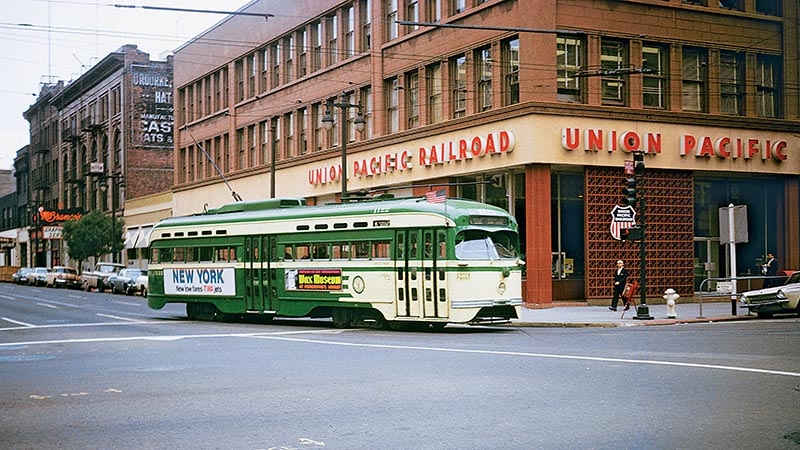
ABOVE: Following the 1948 delivery of the ten Torpedoes, SFMR ordered 25 single-ended PCCs. These were the last new PCCs built in the United States. But as the Iron Monsters aged, additional capacity was still needed. Beginning in 1957, second-hand PCCs were acquired from St. Louis Public Service in the form of 70 cars, which were upgraded and repaint-ed in St. Louis before delivery. Now 20 years old, Car 1122 passes Union Pacific’s San Francisco office building in 1966. —Photo by Bruce Battles, LTL
In a loosely structured vicarious vacation, seen through the lenses of many experienced railfan photographers who have come before us, endured the travails of travel, missed their connections, experienced the frustration of weather, accepted the expenses of transportation, food and lodging and ultimately succeeded with the memorable images contained within these pages… let us enjoy the fruits of their labors. Travel with us for a trip back in time through the images provided by explorers endowed with the curiosity to investigate and preserve history. Just be on the lookout for a speeding Mustang GT with screeching tires being chased by a Dodge Charger — it could happen as we look back at San Francisco transportation. We’ll establish a 25-year parameter “look-back” at history, but offer flexibility and extend some liberties should a worthy image exceed these arbitrary restrictions. That said, our timeframe will be 1950 through 1975, a period of transition — some less desirable, if not interesting.
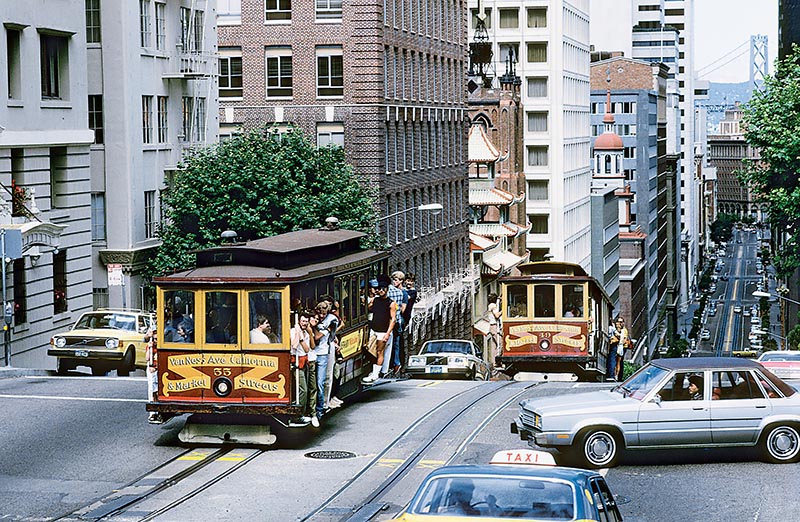
Change, sometimes couched in the name of “progress,” is often difficult to accept. With a cushion of 45 to 70 years, hopefully the rough or raw edges are less painful, the progress measurable and those changes actually discernable as improvement. Throughout our 25-year focus, equipment operated by the San Francisco Municipal Railway metamorphosed across its assemblage of streetcars, electric trolley-busses, internal-combustion and hybrid busses. Only the cable cars, being both mobile transportation equipment and listed on the National Register of Historic Places, replicate their original design and operation. Maintained to the highest of standards, the cable car system is actually a fallback to near-prehistoric concepts and times. Their radical design is the last of its type in the world. The original idea, a San Francisco phenomenon, traces back nearly 150 years. The current cable car system is reduced in scope from its zenith to a much more modest operation, but the fact that it continues to function as first envisioned is simply amazing.
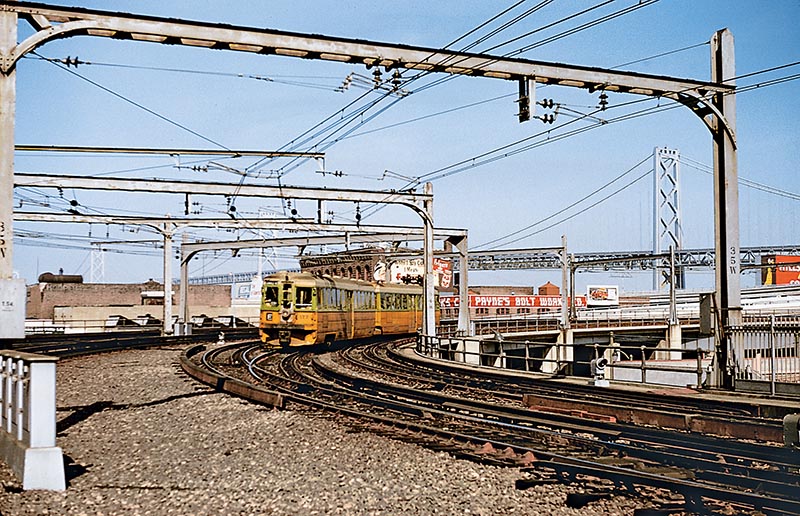
ABOVE: Until April 20, 1958, San Francisco’s transit regimen included the trains of the Key System, which traversed the San Francisco-Oakland Bay Bridge and arrived at the Transbay Terminal. Key System trains once shared trackage on the bridge with Sacramento Northern and Interurban Electric Railway, but they used their own third-rail for power. Key 177 is one of a fleet of “Bridge Units,” that were completed at their shops in Emeryville. They originally converted older cars, but this is one of the newer cars whose body was built new specifically for this service. Before the bridge was opened in 1939, the Key system funneled passengers to the ferries. —Photo by Charles M. Benson, from Robert P. Townley, LTL
During the 1950s, a mix of “standard” streetcar designs operated in concert with a small fleet of pre-PCC equipment, ordered-new PCC’s and a larger group of secondhand PCC’s. In the 70s, a fleet of modern Boeing-Vertol LRV’s was intended to be a replacement for the aging fleet of streamliners. Although they exhibited modern design and ideas, the LRV proved to be troublesome and short-lived. While not generally topics for the pages of this magazine, a fleet of Mack diesel busses served the city well for many years, as did trolley-busses from three manufacturers. Over time, modernized equipment of both varieties eventually took the place of the legacy equipment.
For the rail and transit historian and archeologist, the locale was ripe for exploration with an amazing variety of vehicles. From a railroad perspective, San Francisco was dominated by the Southern Pacific. In fact, corporate headquarters could be found at One Market Street, virtually across the street from the Ferry Building. The edifice remains today, the proud railroad now a substantial portion of Union Pacific. While appreciation for the yellow conglomerate is significant, many of us believe the former Espee lines are the most important parts of that huge system. Southern Pacific was indeed a mega-player in California — it dominated most aspects of railroad transportation in the Golden State.
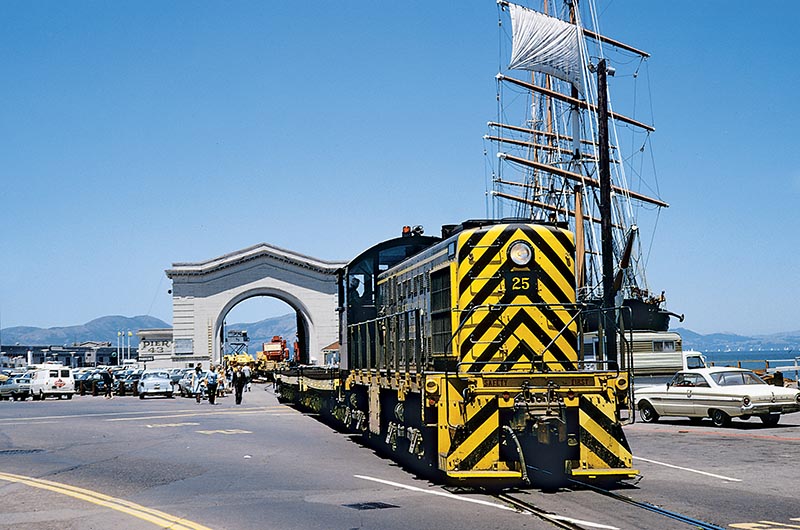
ABOVE: Servicing the car float operation was serious business. Care need be taken handling, loading and unloading the freight cars, lest the barge or ferry apron be damaged. Idler cars were utilized to keep the heavy locomotives off the apron. On June 19, 1968, State Belt ALCO S2 25 switches Pier 43, the railroad’s connection to Northwestern Pacific, Santa Fe, and Western Pacific traffic. State Belt connected with Southern Pacific near their passenger station at 3rd and Townsend. —Photograph by Gordon E. Lloyd, LTL
And, although tracks did not extend from a railhead in San Francisco for either Santa Fe or Western Pacific, their presence was enabled via cross-bay carfloat connections, providing an option for those industries not serviced by Southern Pacific. The extensive waterfront piers owned by the state of California were capably serviced by the State Belt Railroad. Southern Pacific and car ferries provided traffic for State Belt destinations. Towards the end of our agreed-to 1950-1975 timeline, the State Belt Railroad was renamed San Francisco Belt Line when the city took over ownership of the piers along the Embarcadero in 1969. Four years later, Kyle Railways was contracted to operate what remained of the once-busy Alco-powered terminal railroad.
Interestingly, many 1950s vacation travelers destined to San Francisco to photograph the wonderment of steam, diesel and electric traction alighted from their train in Oakland (or Richmond), not San Francisco. It was a function of geography. Cross-country trains did not make the final stop in the City by the Bay, but in neighboring Oakland. Trains such as the City of San Francisco and California Zephyr disgorged their eager riders at the Oakland Mole, a ferry boat transporting them across San Francisco Bay to the Ferry Building, where the hoped-for adventure would then begin. The Mole was a long wharf that jutted out into the bay that offered a tantalizing railroad distraction. One could wile-away multiple hours with the action that accompanied the comings and goings of multiple long-distance trains, train make-up and head-end switching. Maritime afficionados would be fascinated by the display put on by cross-bay ferries, adorned with the corporate name, “Southern Pacific.” They provided the final act of making a water crossing to bring patrons to their ultimate destination.
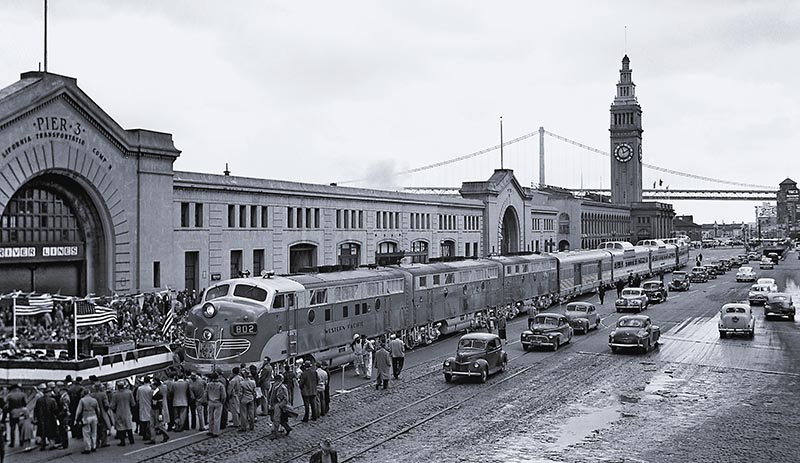
ABOVE: As far as can be determined, this was the only time that the Western Pacific’s famous California Zephyr visited San Francisco. The occasion was the inauguration of the new train on March 19, 1949. That day’s train, consisting of three F3’s and 11 cars, was delivered by the Southern Pacific to the State Belt Railroad where it was displayed in front of the Ferry Building (with the clock tower), stretching all the way to Pier 3. Actress Eleanor Parker christened the train with a bottle of champagne. —Photo by Robert P. Townley, LTL
Stepping off the ferry in San Francisco, eager travelers would walk through the Ferry Building. In the 1940s and 1950s, they would find a dizzying assemblage of streetcars willing to take them to many points and/or make connections with alternate modes of transit capable of dealing with the rigors of the hilly terrain. As our 1950s survey begins, the Market Street Railway has been gone since 1944, consumed under the public ownership of the Municipal Railway, opera-tor of all-things transit throughout Fog City.
The introduction of containerized freight and San Francisco’s reluctance to seriously embrace the new mode of shipping doomed the city as a long-term distribution destination, as Richmond became the westernmost destination for many intermodal trains. Further, the land on which both local businesses served by, and the State Belt /San Francisco Belt itself operated, was coveted for more “appealing” purposes. Beautification projects targeted such businesses, facilities and even some of the piers. It was hardly a recipe that embraced the workaday chores performed by the municipally-owned railroad or those similar assignments of Santa Fe and Western Pacific. Eventually, even Southern Pacific was seriously wounded with the loss of local freight as the city was transformed…